How to Avoid Mold Risks: A Definitive Guide to Structural Health
The presence of fungal growth within the built environment is a biological inevitability when structural governance fails to manage the balance of moisture and temperature. Mold is not an external invader in the traditional sense; it is a ubiquitous opportunistic organism whose spores are present in almost every indoor air sample. The challenge for property owners and facility managers is not the total eradication of spores, which is physically impossible in a non-sterile environment, but the rigorous suppression of the conditions that allow these spores to transition from a dormant state to active, destructive colonies.
Modern construction techniques, while excelling in thermal efficiency, have inadvertently increased the risk of systemic fungal colonization. By creating “tight” building envelopes designed to prevent energy loss, we have reduced the natural air exchange rates that historically helped dissipate indoor humidity. When a highly insulated building suffers a minor envelope breach or a mechanical failure in its climate control system, the resulting moisture is trapped within wall cavities, creating an incubation chamber that remains invisible until the structural damage is profound.
Understanding the mechanics of moisture migration is central to any long-term mitigation strategy. Moisture does not simply sit on surfaces; it moves through materials via capillary action, vapor pressure, and thermal bridging. To address these risks effectively, one must move beyond the superficial application of biocides and engage with the physics of the building itself. This involves a shift from reactive cleaning to proactive structural management, viewing the home or office as a dynamic system where ventilation, insulation, and drainage must work in perfect synchronization.
This analysis serves as a definitive reference for the systemic prevention of indoor fungal growth. We will examine the electrochemical and biological drivers of colonization, the failure modes of modern building materials, and the rigorous governance protocols required to maintain an inert indoor environment. By integrating mechanical engineering principles with microbiological realities, we provide a framework for creating structures that are naturally resilient to biological degradation.
Understanding “how to avoid mold risks”
The primary difficulty in mastering how to avoid mold risks lies in the invisibility of the early colonization phases. Most property owners define a mold problem by visible staining or a characteristic musty odor. However, from a microbiological perspective, by the time these signs manifest, the fungal colony has already established a mature hyphal network within the substrate. Therefore, avoidance is not a matter of cleaning; it is a matter of “Moisture Accounting.” Every gallon of water introduced into the indoor environment—whether through cooking, bathing, or a minor pipe weep—must be accounted for and mechanically exhausted.
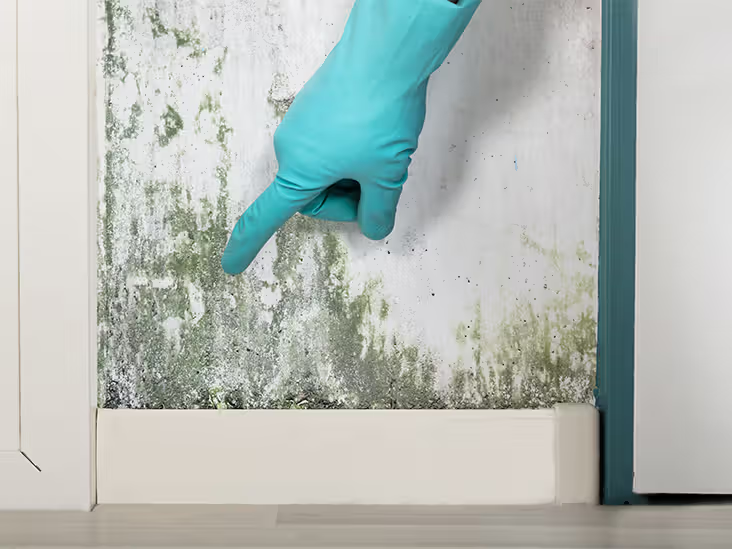
A common misunderstanding is the reliance on “Anti-Mold” paints and coatings as a primary defense. While these products contain fungicides that prevent surface growth, they do nothing to address the moisture accumulation occurring behind the drywall or under the flooring. Oversimplification in this domain often leads to “Surface-Level Complacency,” where a resident assumes that because they cannot see mold on the walls, the air quality is safe. In reality, the most dangerous risks often stem from “Interstitial Condensation,” where warm, humid air hits a cold surface inside a wall assembly, feeding hidden colonies that release spores and mycotoxins into the living space through electrical outlets and baseboards.
A sophisticated avoidance strategy requires a multi-perspective audit of the building’s “Psychrometrics”—the study of the thermodynamic properties of moist air. One must understand the “Dew Point” of various structural layers. If the temperature of a structural component drops below the dew point of the surrounding air, condensation is a mathematical certainty. Avoidance, therefore, is achieved by either lowering the indoor humidity or ensuring that structural surfaces stay warm through continuous insulation and the elimination of thermal bridges.
Deep Contextual Background: The Evolution of Fungal Risk
The relationship between human shelter and mold has shifted from a nuisance of the damp to a systemic crisis of modern engineering.
The Permeable Era (Pre-1970)
Historically, buildings were “leaky.” While they were expensive to heat and cool, the constant exchange of indoor and outdoor air meant that moisture rarely reached the critical concentrations required for mold blooms. Traditional materials like lime plaster and solid wood were also “hygroscopic”—they could absorb and release moisture without losing structural integrity or fostering rapid fungal growth.
The “Tight” Building Revolution (1970–2000)
Following the energy crises of the 1970s, construction shifted toward maximum air-tightness. The introduction of vapor barriers, high-efficiency windows, and fiberglass insulation created “Thermos-like” structures. While energy costs dropped, these buildings lost their ability to “breathe.” Minor leaks that would have dried out in an older home now became permanent wet spots, leading to the rise of “Sick Building Syndrome.”
The Engineered Material Era (Present)
Today’s widespread use of “Processed Cellulosic Materials”—specifically paper-faced drywall and oriented strand board (OSB)—has provided an ideal food source for mold. Unlike solid timber, these processed materials have high surface areas and absorb water quickly, allowing molds like Stachybotrys chartarum to colonize within 48 to 72 hours of initial wetting. We are essentially building homes out of mold food and sealing them in plastic.
Conceptual Frameworks and Mental Models
To effectively navigate the risk landscape, one must adopt specific mental models used by building scientists and industrial hygienists.
1. The Mold Triangle
Like fire requires heat, fuel, and oxygen, mold requires three specific conditions: Spores, Food (Organic substrate), and Moisture. Since spores and organic food (dust, wood, paper) are always present, the only controllable variable is moisture. This model forces the planner to treat every renovation or maintenance task as a water-management exercise.
2. The “Building as a Lungs” Framework
This model suggests that a house must inhale fresh air and exhale moisture. If the “exhalation” (exhaust fans, dehumidification) is weaker than the “inhalation” (humidity from showers, cooking, breathing), the building will eventually suffer from “Moisture Congestion.”
3. The Thermal Bridge Theory
Visualize the building envelope as a thermal circuit. Any break in insulation—such as a steel stud or a poorly insulated window frame—is a “Short Circuit” where heat escapes. These cold spots are where moisture will inevitably condense. Avoidance is achieved by “breaking” these bridges with continuous exterior insulation.
Key Categories: High-Risk Zones and Material Dynamics
Fungal risks are not distributed equally across a structure; they cluster in zones where temperature differentials are highest.
| Risk Category | Primary Failure Mode | Material Vulnerability | Mitigation Logic |
| Below-Grade | Hydrostatic Pressure | Porous Concrete / Drywall | Exterior waterproofing + Sump pump |
| Wet Rooms | Improper Exhaust | Grout / Cabinetry bottoms | 10-minute fan timers + Non-porous finishes |
| Attic Spaces | Roof leaks / Ice dams | OSB Sheathing / Insulation | Ridge vents + Air sealing floor |
| HVAC Systems | Dirty Coils / Standing Water | Internal fiberglass liners | UV-C lights + MERV 13 filtration |
| Windows | Thermal Bridging | Wood sills / Drywall returns | Dehumidification to 45% RH |
| Basements | Capillary Rise | Carpet over slab | Closed-cell foam insulation |
Decision Logic: The Permeability Trade-off
When selecting materials, the professional asks: “If this gets wet, can it dry?” A budget material like standard drywall is “Semi-Permeable” but disintegrates when wet. A high-performance material like magnesium oxide board or cement board is “Inert.” In high-risk zones (basements and bathrooms), the logic dictates using inert materials that do not provide a food source (cellulose) even if moisture control fails temporarily.
Detailed Real-World Scenarios: Decision Logic and Failure Modes
Scenario A: The “Invisible” Window Leak
A modern home with high-efficiency windows shows no signs of leaking, but the wall beneath a window begins to soften.
-
The Cause: Improper “Flashing.” Water is entering behind the siding, bypassing the window frame, and saturating the wall cavity.
-
Failure Mode: The fiberglass insulation acts as a sponge, holding water against the paper-faced drywall from the inside.
-
The Result: A massive fungal colony grows within the wall, undetected until the drywall physically fails.
-
Avoidance Strategy: Implementation of a “Rain Screen” system that allows a drainage plane between the siding and the house wrap.
Scenario B: The Oversized Air Conditioner
A homeowner installs a larger AC unit thinking it will cool the house better.
-
The Cause: “Short-Cycling.” The unit cools the air so fast that it doesn’t run long enough to pull humidity out of the air.
-
Failure Mode: The air is 68°F but the relative humidity is 70%. Cold, damp air creates condensation on supply vents and behind furniture.
-
Avoidance Strategy: Manual J calculation to ensure the HVAC is sized perfectly for the square footage, ensuring long run-times for effective dehumidification.
Planning, Cost, and Resource Dynamics
The economics of mold avoidance are defined by the “Cost of Remediation vs. Cost of Prevention” ratio. Professional remediation of a 10×10 room can cost $5,000–$15,000, whereas the preventive measures are often incremental.
Range-Based Resource Dynamics for Prevention
| Intervention | Initial Cost | Maintenance | Risk Reduction |
| Whole-Home Dehumidifier | $1,500 – $3,500 | Annual filter ($80) | 85% (High Impact) |
| Foundation Drainage | $3,000 – $10,000 | Bi-annual jetting | 95% (Below grade) |
| Smart Leak Sensors | $200 – $600 | Battery change | 70% (Burst pipe only) |
| Enhanced Exhaust Fans | $150 – $400 | Dusting fan | 60% (Zone specific) |
The “Opportunity Cost” of ignoring these systems is the potential loss of “Structural Equity.” A home with a history of systemic mold is often stigmatized in the real estate market, potentially losing 10-20% of its resale value.
Tools, Strategies, and Support Systems
-
Hygrometers: Low-cost sensors placed in basements, attics, and bathrooms to provide real-time Relative Humidity (RH) data.
-
Infrared (Thermal) Cameras: Used to detect “Cold Spots” and hidden moisture behind walls without destructive testing.
-
HEPA Air Scubbers: Utilized during any renovation to ensure that dust (which carries spores) does not migrate to other parts of the building.
-
Boric Acid Treatments: Applying borate-based solutions to raw wood during construction to make it toxic to mold and insects.
-
Encapsulated Crawlspaces: Sealing the ground with a 20-mil vapor barrier and adding a dedicated dehumidifier to eliminate the largest source of indoor moisture.
-
Sump Pump Battery Backups: Ensuring that a power failure during a storm does not lead to a basement flood.
-
ERV/HRV Systems: Mechanical lungs that exchange indoor and outdoor air while recovering thermal energy, ensuring fresh air without spikes in humidity.
Risk Landscape and Failure Modes
Biological risks within a structure are rarely isolated; they are “Compounding Risks.”
-
The “Stack Effect” Hazard: Warm air rises and escapes through the attic, pulling damp air from the crawlspace or basement up through the living floors. If the basement is moldy, the entire house becomes contaminated via this vertical airflow.
-
The Vacation Failure: Turning off the AC during a summer vacation allows indoor humidity to spike to 80%+. In just one week, a fine “Dust Mold” can colonize every soft surface (books, clothes, upholstery) in the home.
-
The “New Home” Moisture Trap: Modern homes use vast amounts of “Wet Trades” (concrete, drywall mud, green lumber). If a new home is occupied and sealed before this structural moisture has evaporated, mold can grow within the first 90 days of ownership.
Governance, Maintenance, and Long-Term Adaptation
Maintaining a mold-inert environment requires a “Governance Protocol” that exceeds standard cleaning.
The Structural Governance Checklist
-
Monthly: Visual inspection of HVAC condensate lines to ensure they are flowing freely and not backing up into the drain pan.
-
Quarterly: Gutter and downspout audit. 90% of basement moisture issues are caused by water falling from the roof and pooling at the foundation.
-
Annual: Professional inspection of the roof “Flashing” (the metal seals around chimneys and vents).
-
Lifecycle Trigger: When replacing a roof or siding, always upgrade to a “Vented” system that allows the structure to dry from both sides.
Measurement, Tracking, and Evaluation
-
Leading Indicator: Relative Humidity (RH). If the indoor environment stays below 50% RH, mold cannot grow, regardless of spore count.
-
Lagging Indicator: Surface “Bio-Film” or staining. By the time this is measured, the protocol has already failed.
-
Documentation Example: A “Moisture Map” created during a home inspection, using a moisture meter to record the “Normal” baseline moisture content of various walls.
Common Misconceptions and Strategic Corrections
-
“Bleach Kills Mold”: Correction: On porous surfaces like drywall or wood, bleach (which is 90% water) kills the surface growth but the water soaks into the material, actually feeding the deep “roots” (mycelium) of the mold. Use an EPA-registered antimicrobial or vinegar instead.
-
“Mold is Only a Problem in Old Houses”: Correction: New houses are often more at risk due to tighter seals and the use of paper-faced drywall.
-
“Closing Vents Saves Money”: Correction: Closing vents in unused rooms creates cold spots and restricts airflow, leading to localized condensation and mold.
-
“Air Purifiers Solve Mold”: Correction: Purifiers remove spores, but they do nothing to stop the colony growth. If the moisture source isn’t fixed, the purifier is just a “band-aid.”
-
“I Can Just Paint Over It”: Correction: Mold will eat the paint from the backside or simply grow through it. You must remove the substrate or professionally clean it first.
Ethical and Contextual Considerations
There is an ethical imperative for landlords and developers regarding “Indoor Environmental Quality” (IEQ). Unlike aesthetic issues, mold is a health hazard that affects residents unequally, with children and those with pre-existing respiratory conditions being most vulnerable. Intellectual honesty in construction requires admitting that “Energy Efficiency” should never come at the cost of “Breathability.” Proper mold avoidance is not just a maintenance task; it is a fundamental component of safe housing and public health.
Conclusion: The Synthesis of Resilience
The mastery of how to avoid mold risks is found in the persistent application of three disciplines: thermal management, humidity control, and material selection. A mold-resistant home is not one that is “poisoned” with biocides, but one that is engineered to be inhospitable to moisture. It is a structure that respects the laws of thermodynamics, acknowledging that water will always seek the path of least resistance. By maintaining the building envelope, governing indoor air quality with mechanical precision, and choosing inert materials, we can create indoor environments that are as durable as they are healthy. The ultimate goal is a structure that stays dry, breathes easily, and remains biologically inert for decades.